
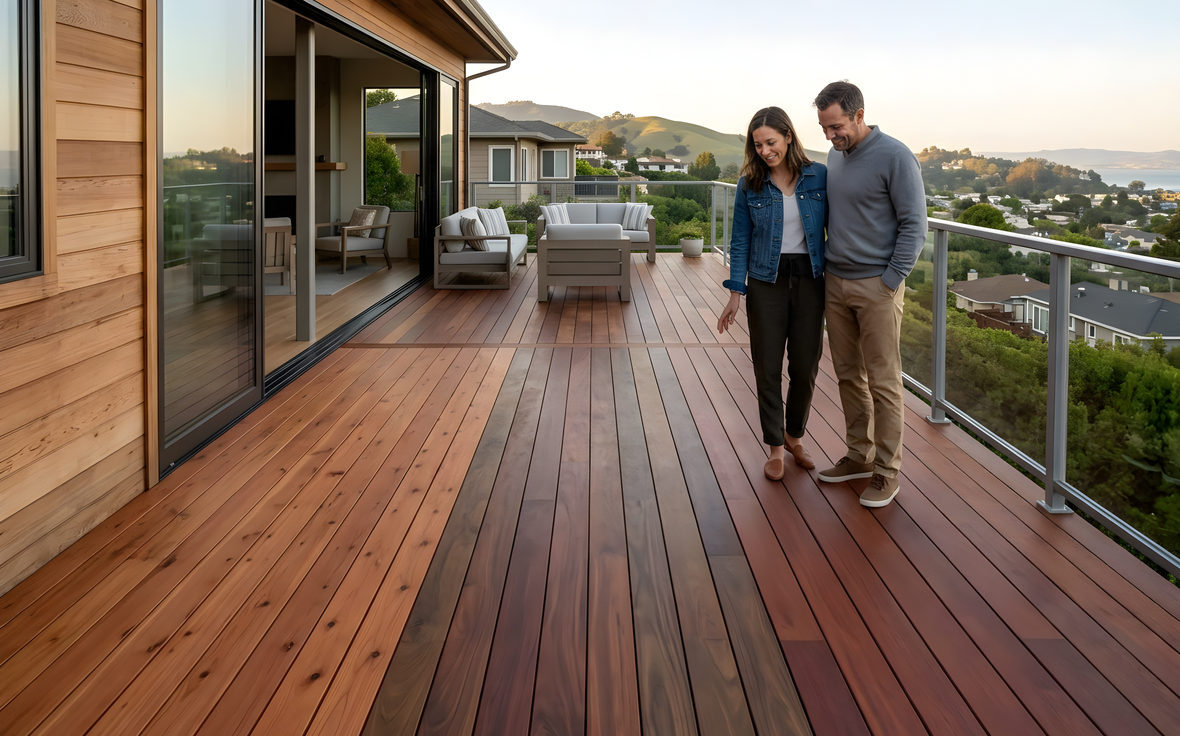
Homeowners researching the best materials for Bay Area decks will inevitably land on three top favorites: Redwood, Ipe, and Red Batu decks.
With over 40 years of experience providing deck construction services across the East Bay, the Duce Construction team can confidently say that all three produce high-quality hardwood deck boards. A homeowner’s decision comes down to several factors, including overall cost, durability, maintenance needs, and aesthetic options. We’ll start with a brief overview of these popular types of wood for decks, then continue with more detail about each.
Redwood is the most accessible of the three, which is why there’s a redwood deck in virtually every neighborhood in our region. If you go the redwood route, make sure you choose Construction Heart Redwood (called Con Heart). Con Heart planks come from the center of the tree, where wood cells are denser, making the planks less vulnerable to cracking or warping in our region’s fog-and-dry cycles. A Red Batu deck is considered mid-premium and may be less familiar to homeowners because it comes from Brazil and is not available at big-box stores. It is harder than redwood but lower-maintenance.
Ipe is another Brazilian hardwood, known as a premium lumber choice. Its Janka hardness rating supersedes the others at 3,680 lbf. An Ipe wood deck also has a Class A fire rating, making it one of the safest hardwood deck options on the market.
How These Woods Compare at a Glance
This table provides a quick comparison of redwood, Red Batu, and Ipe.
A Note on Pricing
You won’t find specific dollar figures in this article, and that’s on purpose. Every Bay Area deck project is unique. Wood species, square footage, substructure needs, site conditions, and permit requirements all move the number, and any single range we published here would be misleading for most readers. For a real number tailored to your property and your goals, contact us for a free on-site consultation and we’ll walk you through an itemized estimate.
| Wood | Janka Hardness | Origin | Maintenance | Lifespan | Cost Tier |
|---|---|---|---|---|---|
| Construction Heart Redwood | ~450 lbf | Pacific Northwest | Stain every 2-3 years | 20-30 years | Most accessible |
| Red Batu | Significantly harder than redwood, in the same performance class as Ipe | Brazil | Periodic oiling | 25-40 years | Mid-premium |
| Ipe | 3,680 lbf | Brazil (rainforest) | Oil annually or let silver | 40-75 years | Premium |
Construction Heart Redwood: The Bay Area Standard
Readily available and locally milled, it’s no surprise that Construction Heart Redwood, Con Heart, is a standard for East Bay decks. And when we say “locally milled,” we mean it.
There are more than 30 grades of redwood, and Con Heart is one of the best of them. It’s known for its beautiful appearance and a dense cellular composition that makes it more tolerant of the Bay Area’s fog-and-dry cycles. It’s considered a low-maintenance deck material, but to extend a redwood deck’s lifespan, you’ll need to stain it every few years. Redwood is the most accessible and affordable type of wood for decks, and you can expect a high-quality, well-maintained redwood deck to last between 20 and 30 years.
Ipe: The Benchmark for Hardwood Deck Performance
Ipe planks are milled from Brazilian walnut trees of the genus Tabebuia. Since Ipe is harvested in Brazilian rainforests, homeowners are encouraged to seek FSC-certified wood. Ipe has a Janka hardness rating of 3,680 lbf, which is significant when compared to a moderate hardwood, like red oak (1,290 lbf).
What to Know Before You Commit to Ipe
Ipe’s density that makes it so durable also makes it demanding to work with. Every plank must be pre-drilled before it’s fastened with stainless steel hardware, since driving a fastener into unpredrilled Ipe will split the board. It also can’t be painted. The wood’s natural oils repel paint adhesion, so any finish is limited to oil treatments. That leaves homeowners with a real choice to make: oil the deck annually to preserve its red hue, or skip the maintenance entirely and let it weather to a silver-gray patina. Either path is structurally sound. It just comes down to which look you want to maintain.
When lumber-related industries talk about wood quality and hardness, they use the Janka hardness rating. This rating was derived from tests measuring a wood’s resistance to denting and wear by calculating the force required to embed a 0.444 inch steel ball halfway into its surface.
Ipe is solidly positioned in the “dense hardwood” category of the Janka scale. In fact, its dense composition makes it so hard that Ipe has received a Class A fire rating, the same classification as other fire-resistant building materials such as concrete and tile. This is important because decks typically join directly to or are built within 5 feet of residential structures, so fire-resistant materials help homeowners achieve zone-zero protection.
This hardwood is so dense that planks must be pre-drilled. It cannot be painted because the dense fibers repel paint. Instead, homeowners have the choice between regularly oiling it to preserve its red hue or letting it weather to a silver patina. While it’s the most expensive and highest-tier option of the three, we think it’s the best choice because you’ll only buy an Ipe deck once, as it lasts for decades. Minimal homeowner maintenance is required for this luxury deck material, which can last up to 75 years.
Red Batu: The Premium Hardwood Most Homeowners Haven’t Heard Of
Red Batu is also a Brazilian tropical hardwood. It has a deep reddish-brown grain. This wood is the least known of the bunch because it isn’t available from big-box stores. A Red Batu deck is harder and more durable than its redwood counterpart. While it isn’t as hard as Ipe, it is in a comparable performance class. It’s also very low-maintenance.
Like Ipe, a Red Batu deck only needs to be oiled if you want to preserve its red-brown hue. Otherwise, you can let it weather naturally to a grey/silver. It is considered the middle tier between redwood and Ipe, with a price point that falls between the two. Red Batu should last between 25 and 40 years, depending on its location, installation, and maintenance history.
How Bay Area Weather Affects Each Wood Differently
We want to be clear that all three wood types, Redwood, Red Batu, and Ipe, are fantastic choices for your deck. If budget is an issue, your redwood deck will do a solid job of weathering the inherent swelling and shrinking caused by the East Bay’s cool, moist, foggy mornings and hotter, drier afternoons. If you have more budget flexibility, we recommend Red Batu or Ipe.
When Duce comes out for an on-site consultation, we consider several factors when helping customers decide between redwood vs Red Batu vs Ipe. For example, if you live in a coastal Berkeley neighborhood, your deck won’t experience the same degree of inland afternoon heat the way Walnut Creek, Concord, or Danville decks do, but the excess moisture may cause you to lean towards one of the harder woods, as their dense grains do a better job of shedding moisture.
If your home is farther inland in a wildlife corridor or in an area known for its higher fire risk, we’ll encourage you to consider Ipe for its fire-resistant properties.
Which Wood Should You Choose?
Your specific location and the East Bay microclimate matter when deciding which wood is best for your deck. If you love the traditional look of wood but are more budget-conscious, redwood is probably the right choice. Despite occasional oiling or staining over the years, redwood is still considered a low-maintenance deck material, and you won’t have to worry about replacing it for at least another two decades.
At a Glance: Which Wood Fits You
Redwood
Best if you want the traditional deck look at the most accessible cost tier, and you don’t mind staining every 2 to 3 years to keep it looking its best.
Red Batu
Best if you want tropical hardwood durability and low-maintenance performance without stepping up to Ipe’s premium cost tier.
Ipe
Best if you want the longest lifespan, the lowest long-term maintenance, and Class A fire-resistant performance, and you’re planning to build once.
If, however, you want something that can survive many years with minimal maintenance and that is also fire-resistant, Ipe is the way to go. Our company works with both Ipe and Red Batu, so we’ll let you know which is the right choice if you’re not quite sure.
Ultimately, deciding on the right deck material for your home or vacation property is only possible after a site visit by a licensed and experienced contractor. Duce Construction Deck and Fence has more than 40 years of experience building decks in and around the East Bay, and that includes equal opportunity use of redwood, Red Batu, and Ipe.
Planning a new deck in the East Bay? Call the number in the sidebar or visit our contact page to schedule a free, on-site consultation.
Frequently Asked Questions
Q1: What is the Janka hardness for Ipe?
A: Ipe is one of the hardest woods on the Janka scale, with a hardness rating of 3,680. Its densely structured wood cells allow it to easily shed moisture and prevent excessive expansion and contraction that occur in the East Bay’s notorious fog-and-dry cycle (cool, foggy mornings and dry, hot afternoons), which can cause softer wood species to crack, split, and decay.
Q2: Why does wood type matter for Bay Area decks?
The Bay Area, and the East Bay in particular, has a very unique climate. For much of the year, coastal fog blankets our properties, leaving wood decks and fences consistently exposed to moisture. Then, once the sun comes out, the fog burns off, and temperatures can get as high as the 90s to 100s.
By its very nature, wood expands and contracts in response to moisture and temperature fluctuations. The softer and less dense the wood cells are, the more they swell up. Then, when they shrink again, they are prone to splitting. This is why hardwood planks are best for decks, making redwood, Red Batu, or Ipe the best picks for decks in our region.
Q3: Is it possible for wood decks to be fire-resistant?
Yes, there are hardwood deck options that are considered fire-resistant. The best fire-resistant options in the East Bay are decks built from Ipe hardwood deck planks. Ipe, a Brazilian hardwood, is so dense that it has been given a Class A fire rating, which means it’s considered as fire-resistant as concrete or tile.
Q4: Do I have to oil or stain my wood deck every year?
Whether you need to oil or stain your wood deck, and how often, depends entirely on the species of wood you choose. Some, like pine, require annual staining to reach their best lifespan, while others, like Ipe, never have to be stained to retain their structural integrity.
Then, products like redwood only require staining every two to three years, which strikes an affordable and labor-respectful middle ground. That said, some homeowners choose to oil their Red Batu and Ipe decks regularly to preserve their natural red/brown wood grain, rather than letting them go grey or silver over time.
Duce Construction Deck and Fence, CA License #1075217, East Bay deck and fence specialists since 1983.
Planning a new deck in the East Bay? Call (925) 595-1020 or visit our contact page to schedule a free, on-site consultation.